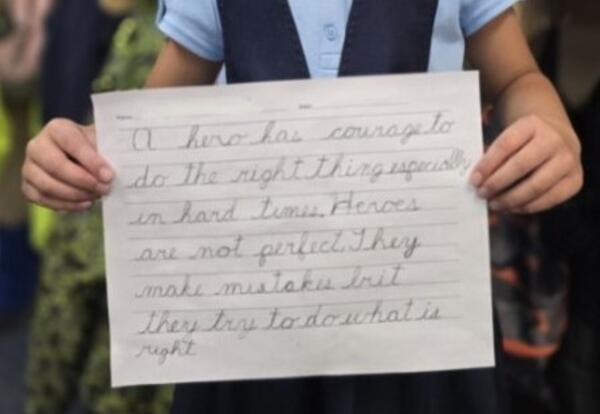
James Irwin Elementary School Kindergarten student's cursive sheet.
And Why It Works!
Walk into a kindergarten classroom at James Irwin Elementary School, and you’ll notice something wonderfully unexpected: students aren’t just learning their letters, they’re learning them in cursive. While many schools across the country have scaled back or eliminated cursive instruction, James Irwin has doubled down, teaching cursive from K–5th grade as a foundational skill rather than an optional addon.
At first glance, this approach surprises people. In a world filled with tablets, Chromebooks, and voice-to-text tools, why would a school choose to emphasize a centuries-old writing style? The answer becomes clear the moment you watch young learners form their first flowing loops and connected strokes. Cursive isn’t a relic here; it’s a powerful tool for early literacy, motor development, and cognitive growth.
Cursive Comes Naturally to Young Learners
If you’ve ever watched a kindergartner draw, you know their hands naturally gravitate toward circles, loops, and sweeping motions. Straight lines and sharp angles, the building blocks of print writing, are more difficult for developing hands. Cursive, with its smooth, continuous strokes, aligns beautifully with how young children naturally move a pencil.
At James Irwin Elementary, teachers harness this instinctive motion. Instead of stopping and starting after every letter, students glide across the page, building confidence and rhythm. This fluidity reduces frustration and helps children internalize letter formation more quickly.
Fewer Reversals, Fewer Tears
One of the biggest challenges in early writing is letter reversals. Print letters like b, d, p, and q look similar and are easy to confuse. Cursive, however, gives each letter a distinct shape and a specific movement pattern. Because students write each letter in one continuous motion, muscle memory kicks in—making reversals far less common.
This is especially helpful for students who struggle with dyslexia or other language-based learning differences. The left-to-right flow of cursive reinforces directionality and strengthens the brain pathways needed for reading and writing.
A Workout for the Brain
Handwriting is more than a motor skill—it’s a cognitive workout. Research consistently shows that writing by hand activates more areas of the brain than typing. Cursive amplifies this effect because it requires coordination, sequencing, and continuous movement.
At James Irwin Elementary, cursive isn’t just about penmanship. It’s about building neural connections that support reading comprehension, memory, and long-term learning. When students learn cursive early, they’re not just learning to write - they’re strengthening the very systems that make literacy possible.
Better Spelling, Better Reading
Because cursive connects letters into whole words, students begin to see language as patterns rather than isolated shapes. Writing “cat” in print means forming three separate letters. Writing it in cursive means creating one smooth, connected motion. This helps students internalize spelling patterns and improves reading fluency.
Teachers at James Irwin Elementary consistently see that students who write in cursive read with greater confidence and fluidity. The rhythm of cursive mirrors the rhythm of language itself.
Focus, Patience, and Calm in a Busy World
Cursive has a quiet magic to it. It slows children down just enough to encourage focus without overwhelming them. The steady, connected motion can be calming—almost meditative. In a world full of instant notifications and digital shortcuts, cursive gives students the gift of sustained attention.
This intentionality spills over into other academic areas. Students learn to sit, concentrate, and complete tasks with care.
No More Awkward Transitions
In many schools, students learn print first and then switch to cursive in later grades—a transition that often feels like learning a whole new language. Some students resist it, and many never fully adopt cursive at all.
James Irwin Elementary avoids this problem entirely by teaching cursive from the start. They can still read print easily—exposure in books and digital text takes care of that—but they never have to relearn how to write.
Preserving a Skill That Matters
Cursive is more than a writing style. It’s a connection to history, culture, and personal expression. Our founding documents, historical letters, and family journals were written in cursive. Signatures still matter. And handwriting—real handwriting—carries personality in a way no keyboard ever will.
By teaching cursive from K–5, James Irwin Elementary ensures that this expressive, meaningful skill remains alive for the next generation.
A Forward Thinking Tradition
Teaching cursive first isn’t about nostalgia. It’s about understanding how children learn best and giving them tools that support their development. At James Irwin Elementary Schools, cursive strengthens motor skills, reduces confusion, boosts reading and spelling, and builds the cognitive foundation for lifelong learning.
In a rapidly changing educational landscape, sometimes the most innovative choice is also the most timeless: giving children the power of connected writing from day one.